
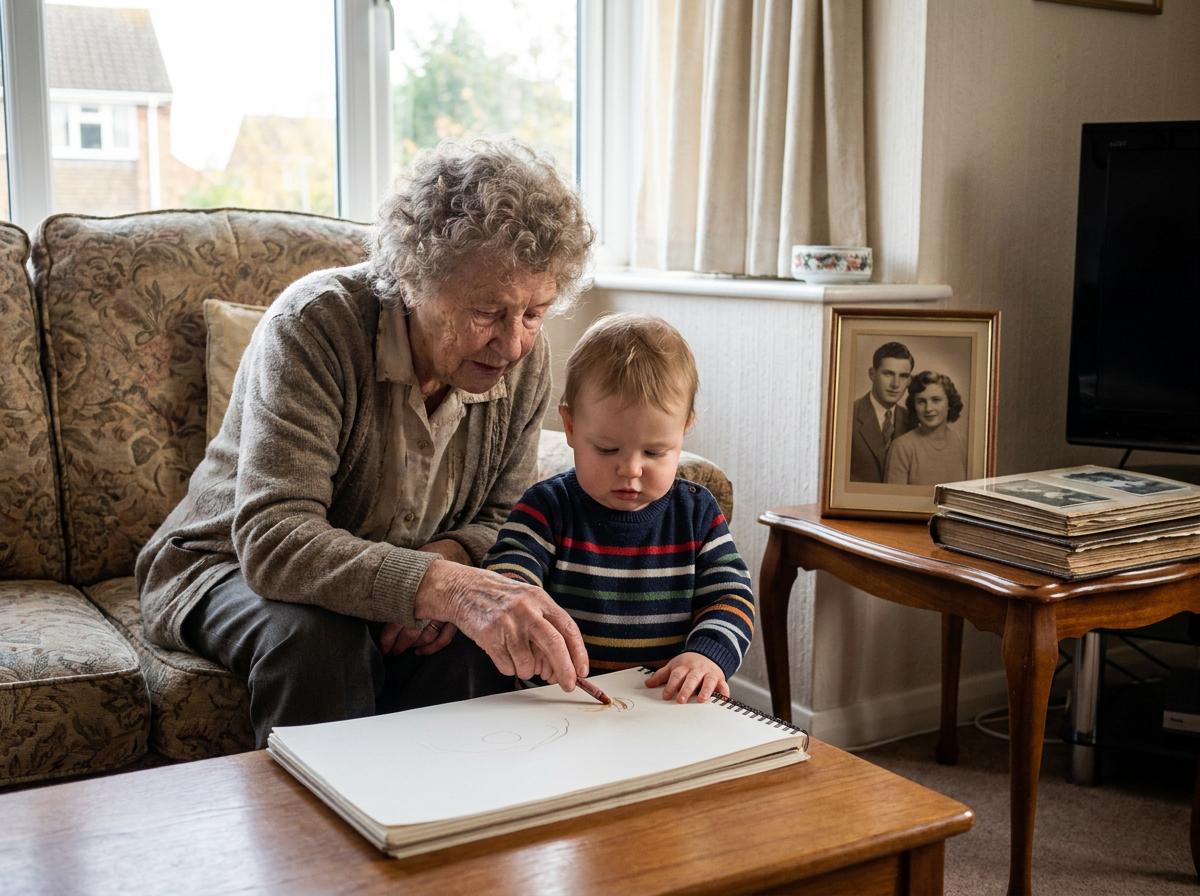
Family resemblances are often discussed when a child is very young. People compare their eyes, nose, hands or smile with those of parents and grandparents, sometimes producing old photographs to prove the point. The more interesting similarities, however, often appear much later, once a child’s personality, interests and sense of humour have begun to develop.
A child might make a comment with exactly the same dry delivery as their grandfather, become absorbed in drawing as their grandmother once did, or show the same determination that has appeared in several generations of the family. These moments are rarely planned or expected. They simply occur in the middle of family life and make somebody pause.
Seeing your parents in your children can bring a particular kind of comfort. It does not mean that a child is a copy of anybody else, or that personality and ability are passed down in a simple and predictable way. The connection is often much less definite than that. It is simply the feeling of recognising something familiar in a person who is also completely themselves.
The most meaningful similarities take time to appear
Physical resemblances are easy to point out because they can be seen. Personality is more complicated. It develops through a mixture of temperament, relationships, experiences and the environment in which a child grows up.
This makes the appearance of a familiar characteristic especially interesting. A child may share a grandparent’s curiosity about how things work, their patience when making something or their habit of helping without being asked. Nobody may notice the connection at first. It can take a particular conversation or situation for the similarity to become clear.
Families are also very good at remembering people through small habits. Somebody may always have sung while cooking, told unnecessarily long stories or refused to leave a practical problem unsolved. These details rarely appear in formal accounts of a person’s life, yet they are often the things relatives remember most clearly.
When the same habit appears in a child, it creates an opportunity to share those memories. The child learns something about the person they resemble, while the adults are reminded of parts of family life they may not have thought about for years.
Shared talents can connect family history with the present
Creative and musical abilities often make connections between generations easier to see. A child who draws constantly may prompt stories about a grandparent who painted, designed clothes or filled notebooks with sketches. An interest in music may remind relatives of somebody who sang, played an instrument or always had music playing at home.
The value of making this connection is not in suggesting that the child has inherited a fixed talent or must follow the same path. Ability develops through encouragement, practice, access to opportunities and personal motivation. Even closely related people can have very different interests and ways of expressing themselves.
The family story can still give a child a sense of context. An old sketchbook, recipe book, photograph or instrument shows that somebody before them enjoyed creating things too. This can be particularly meaningful when the child never knew that person well, or when they were too young to remember them.
Family belongings can become more interesting when children understand the person behind them. A battered guitar is no longer simply something stored in the loft if it comes with stories about who played it and when. A painting means more when somebody explains where it was made, why it mattered or how the artist felt about their work.
Humour carries more family history than we realise
A shared sense of humour can be one of the most recognisable similarities because humour involves far more than the words somebody uses. Timing, facial expressions and the way a story is told all contribute to it. Families also develop their own collection of repeated jokes, phrases and references that make little sense to anybody outside them.
When a child shares a grandparent’s wit or storytelling style, the resemblance may feel more immediate than a physical similarity. It can remind relatives of real conversations and familiar family occasions, rather than simply bringing to mind a photograph.
Some of this may come from the child absorbing the language and humour around them. Family stories are retold, expressions are repeated and ways of responding to situations become part of the household culture. Other similarities may appear even when a child had little contact with the person they resemble.
There is no need to decide exactly where every characteristic came from. What matters is that the similarity prompts a memory and gives the family a reason to share it. Children often learn far more about relatives through these informal conversations than they do from names, dates and carefully organised family trees.
Familiar traits can bring comfort and sadness together
Recognising a parent in your child may feel different when that parent is growing older, unwell or no longer alive. The similarity can be reassuring, particularly when it brings back a part of them that photographs cannot fully capture. It may also highlight the fact that they are not there to see the child develop.
Family milestones often create this mixture of emotions. A child may discover a talent their grandparent would have encouraged, reach an achievement they would have celebrated or develop into somebody they would have enjoyed knowing. Happiness about the child and sadness about the missing person can exist alongside one another.
Talking about the resemblance can make space for both. Rather than referring to a relative only in the context of their death, families can describe how they lived, what interested them, what made them laugh and what they found difficult. This helps children understand them as people rather than distant figures from the past.
It also allows memories to remain part of normal family conversation. Remembering somebody does not always have to take the form of a serious discussion or a special occasion. It can begin with an expression across the dinner table or a joke that sounds remarkably familiar.
A resemblance should not become an expectation
Affectionate comparisons can help children understand their place within a wider family story. They can also become limiting when they are repeated too strongly. A child who is constantly described as “just like” a particular relative may begin to feel that other people have already decided who they are.
The language used around family similarities matters. Saying, “Your grandmother loved drawing too,” offers information and perhaps an invitation to hear more. Saying, “You are going to be the artist in the family,” turns the connection into an expectation.
Children may share a talent with one relative, a personality trait with another and interests that nobody else in the family understands at all. These differences are as important as the similarities. Family identity should provide a sense of belonging without placing children into roles they have not chosen.
A familiar trait is best treated as a point of connection rather than a prediction. The child may continue with the interest, adapt it in a completely new direction or leave it behind as they grow. None of these choices diminishes the family link.
Ordinary qualities are part of a family’s inheritance too
Talent and humour are easy to notice, but some of the most important family similarities are quieter. A child may have a relative’s patience, loyalty or ability to make other people feel comfortable. They may respond to difficulty with a steadiness that reminds the family of somebody who faced challenges in much the same way.
These qualities can easily be overlooked because families tend to preserve stories about achievements and significant events. Children may know where a grandparent worked or what they accomplished without knowing how they treated people in everyday life.
Pointing out these smaller connections adds depth to the family story. A comment such as, “Your grandad always noticed when somebody needed help too,” tells the child something about both the relative and the values the family remembers. It recognises the child’s own behaviour without suggesting that it belongs entirely to somebody else.
Seeing parents in children is not really about proving which qualities have been inherited. It is about noticing how family influence continues through stories, habits, relationships and the ways people respond to one another.
Each child creates their own combination from everything they receive and experience. They may occasionally remind the family of somebody who came before them, while still becoming a person nobody could have predicted. Perhaps that balance between familiarity and difference is what makes these moments so meaningful.
Which characteristic in your child has unexpectedly reminded you of somebody else in your family?
Leave a Reply