
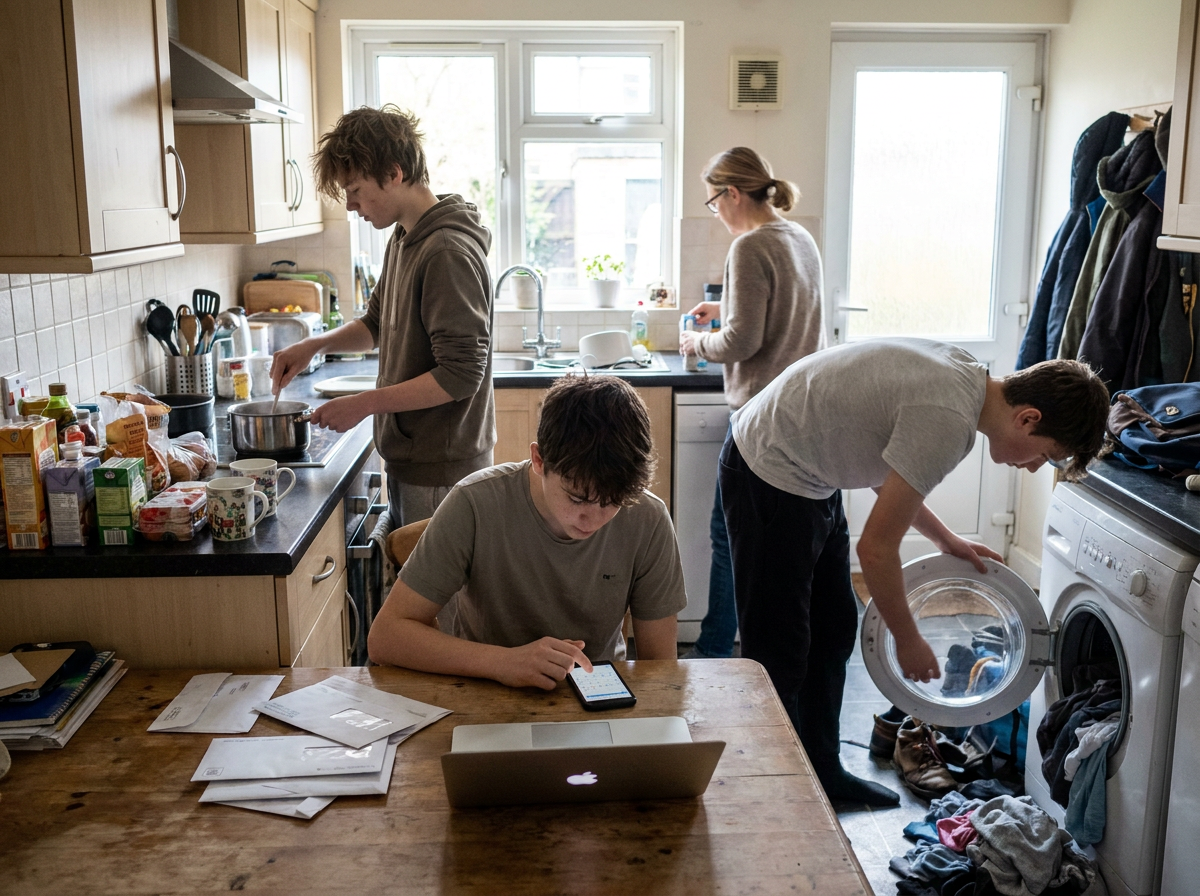
Teenagers can spend years working towards qualifications and still reach adulthood unsure how to: read a payslip; arrange a medical appointment; or make a meal from what is left in the fridge. This is not evidence that schools have failed or that families have been careless. It reflects a simple difficulty: the skills that keep everyday life moving are spread across home, education, work and the wider community, with no single place responsible for joining them together.
Conversations about life skills for teenagers often become lists of chores. Cooking, laundry and cleaning matter, yet practical independence is much wider. It includes judgement, communication, planning, digital safety, emotional regulation – and the confidence to ask for help before a manageable problem becomes a crisis. A young person does not need to know everything. They need enough experience to take a sensible next step when they do not know.
UNICEF describes transferable skills as spanning critical thinking, problem-solving, decision-making, communication, negotiation, cooperation, resilience and self-management. This broader view is useful because adulthood rarely presents one neat task at a time. Missing a train may involve money, time, emotion, communication and a revised plan within the same ten minutes.
Independence Grows Through Participation
Independence is sometimes mistaken for the withdrawal of support. A teenager reaches a certain age, an adult stops reminding them, and the resulting difficulty is treated as a lesson. Natural consequences can be useful, but being left to fail without preparation is not the same as learning.
A more reliable path moves gradually from watching to sharing, then to leading. An adult might first explain how they compare two mobile phone contracts. The next time, the teenager gathers the information. Later, they make a recommendation and explain the trade-offs. Eventually, they handle a similar decision themselves, knowing that advice remains available.
This approach resembles the gradual scaffolding used in education. The Education Endowment Foundation’s guidance on metacognition emphasises helping pupils plan, monitor and evaluate their work, with support adjusted over time. The same rhythm fits ordinary family life: think ahead, attempt the task, notice what happened and decide what to change.
Money That Exists Beyond a Budget Worksheet
Money skills are not simply the ability to add income and subtract spending. Teenagers need to recognise what money feels like in real life. Contactless purchases that barely register, subscriptions that continue quietly, an appealing credit offer, a fraudulent message that creates urgency, or a first payslip filled with unfamiliar deductions.
Useful practice can begin with genuine household decisions. A teenager can cost a meal, compare the price per unit rather than the shelf price, plan travel within a fixed amount or work out the annual cost of a monthly subscription. Older teenagers can learn the purpose of tax, National Insurance, pensions, rent, deposits, bills and an emergency buffer without being expected to absorb the entire financial system in one conversation.
MoneyHelper recommends giving teenagers increasing financial responsibility, setting an example and discussing digital money as well as cash. Openness matters more than pretending adults always make perfect decisions. A calm explanation of a regretted purchase or an unexpected bill can reveal how financial choices are repaired, not just how they should have been made.
Food and the Work of Running a Home
Being able to cook one impressive dish is less useful than being able to feed oneself repeatedly. A practical starting point is a small collection of adaptable meals: something using eggs, a pasta or rice dish, a tray meal, a soup or curry, and one meal assembled from inexpensive store-cupboard ingredients. Planning, shopping, food storage, allergy awareness and basic hygiene belong to the skill as much as the cooking itself.
The same principle applies around the home. Teenagers benefit from knowing how to sort and wash clothes, change bedding, clean a bathroom, recognise when food is unsafe, reset a tripped switch and locate the stopcock. Nobody has to become an expert plumber. The goal is to tell the difference between a task that can be attempted safely and one that needs a responsible adult or qualified professional.
Domestic competence should not follow gender or silently settle on the most compliant child. When every family member learns how the household works, practical knowledge and mental load are shared more fairly. Contribution also carries a useful message: teenagers are not visitors being prepared to leave; they are members of the household whose work already matters.
Communication and Self-Advocacy
Many adult tasks begin with contacting somebody unfamiliar. Booking an appointment, querying a charge, emailing a tutor, speaking to an employer or explaining an access need can feel disproportionately difficult when every part of the exchange is new. Confidence grows through rehearsal and real use rather than an instruction to “just ring them”.
A teenager might write down the reason for the call, the information they need and the questions they want answered. An adult can stay nearby for the first attempt, then step back next time. Similar practice can cover writing a clear email, leaving a voicemail, asking for clarification and keeping a record of what has been agreed.
Self-advocacy also includes boundaries. Young people need language for disagreeing respectfully, saying no, recognising pressure, apologising properly and returning to a difficult conversation. The Department for Education’s revised relationships, sex and health education guidance, introduced from September 2026, reinforces the importance of respectful relationships, safety and informed decision-making. Families give these ideas their daily setting through the way disagreement, privacy and consent are handled at home.
Time, Administration and Digital Life
Adult life contains an extraordinary amount of invisible administration. Dates must be remembered, forms completed, documents stored and plans adjusted when two commitments collide. Teenagers who appear disorganised may not lack care; they may be trying to hold a complicated system in their heads without having been shown an external one.
A shared calendar, reminders, a simple weekly review and a secure place for important documents can reduce that load. Teenagers can practise checking a journey before leaving, allowing contingency time, reading the full instructions on a form and breaking a deadline into smaller actions. The method can be adapted for neurodivergent young people rather than treating one style of organisation as proof of maturity.
Digital competence needs to go beyond using apps fluently. Strong unique passwords, two-factor authentication, scam awareness, privacy settings, backups and the ability to judge a source all protect real parts of life. Knowing how to stop, verify a request independently and speak to somebody trusted is often more valuable than memorising a list of current scams, which will soon change.
Health, Wellbeing and Knowing When to Ask
Looking after health involves a mixture of routine and judgement. Teenagers can gradually learn how to register with a GP, request a repeat prescription, describe symptoms, understand basic medicine labels and find reliable health information. Sleep, movement, food, dental care and sexual health should be discussed as ordinary parts of wellbeing rather than subjects raised only when something has gone wrong.
Emotional independence does not mean managing distress alone. It means recognising a change, using strategies that genuinely help and knowing when additional support is needed. A capable young adult may still call a parent, friend, GP, tutor or helpline. Interdependence—the ability to act and to draw appropriately on other people—is a healthier goal than total self-sufficiency.
Decision-Making, Mistakes and Repair
Teenagers need chances to make decisions whose consequences are real but survivable. Choosing how to use a modest budget, planning a family journey or taking responsibility for a booking creates a reason to compare options and think ahead. Adults may see a faster route, a cheaper choice or an obvious risk, yet taking over every decision removes the part in which judgement develops.
The most useful conversation often happens afterwards. What worked? What was missed? What would make the next attempt easier? This is different from conducting an inquest until the teenager wishes they had never tried. Repair is itself a life skill: contact the person affected, acknowledge the problem, make a revised plan and follow through.
Some consequences are too serious for experimentation. Safety, exploitation, high-cost borrowing and irreversible commitments require firmer boundaries and more direct guidance. Growing autonomy is not the absence of adult responsibility; it is a continuing judgement about which risks can teach and which risks need to be contained.
What Schools Can Teach—and What They Cannot Recreate
Schools play an important role in relationships and health education, citizenship, careers, financial understanding and the habits of planning and reflection. They cannot reproduce every tenancy agreement, workplace conversation, family budget or medical decision a young person will encounter. Even an excellent lesson remains different from using the skill when the outcome matters personally.
Families should not carry this responsibility alone either. Time, money, confidence and opportunity are unevenly distributed. A parent who has never understood pensions or who is surviving on an unpredictable income cannot be expected to deliver a polished financial curriculum at the kitchen table. Schools, youth services, employers, community organisations and reliable public information all form part of the support system.
The aim is not to identify another area in which adults feel they are falling short. It is to notice where everyday life already contains a small, usable opportunity. One teenager can check the train times. Another can cook alongside somebody. A young person can listen while a bill is queried or help compare prices for the weekly shop. Ordinary participation accumulates.
A Simple Way to Build Life Skills for Teenagers
Rather than creating a long checklist, choose one area that is becoming relevant now. Use a five-stage process: show the task, do it together, let the teenager lead with support nearby, let them handle it independently, then review only what will help next time. Stress, illness, exams and periods of change can sometimes set progress back. When that happens, young people may need more support again, and that should never be treated as a failure.
Expect uneven development. A teenager may travel across a city confidently but avoid making a phone call. Another may cook for the family and still lose every important letter. Disability, anxiety, neurodivergence, culture and previous opportunity all shape which tasks are straightforward. Fair preparation does not mean identical expectations; it means each young person gains the tools and adjustments they will actually need.
The most important life skills for teenagers are not a performance of adulthood. These everyday skills give young people a sense of agency: knowing enough to make informed choices, playing an active part in family and community life, finding their feet when something goes wrong, and knowing when to ask someone with more experience for help. Young people develop these skills gradually through ordinary family life, long before anyone hands them a set of keys and declares them independent.
[…] children announce their questions. Teenagers may pursue interests privately, through videos, music, sport, fashion, gaming, online communities […]