
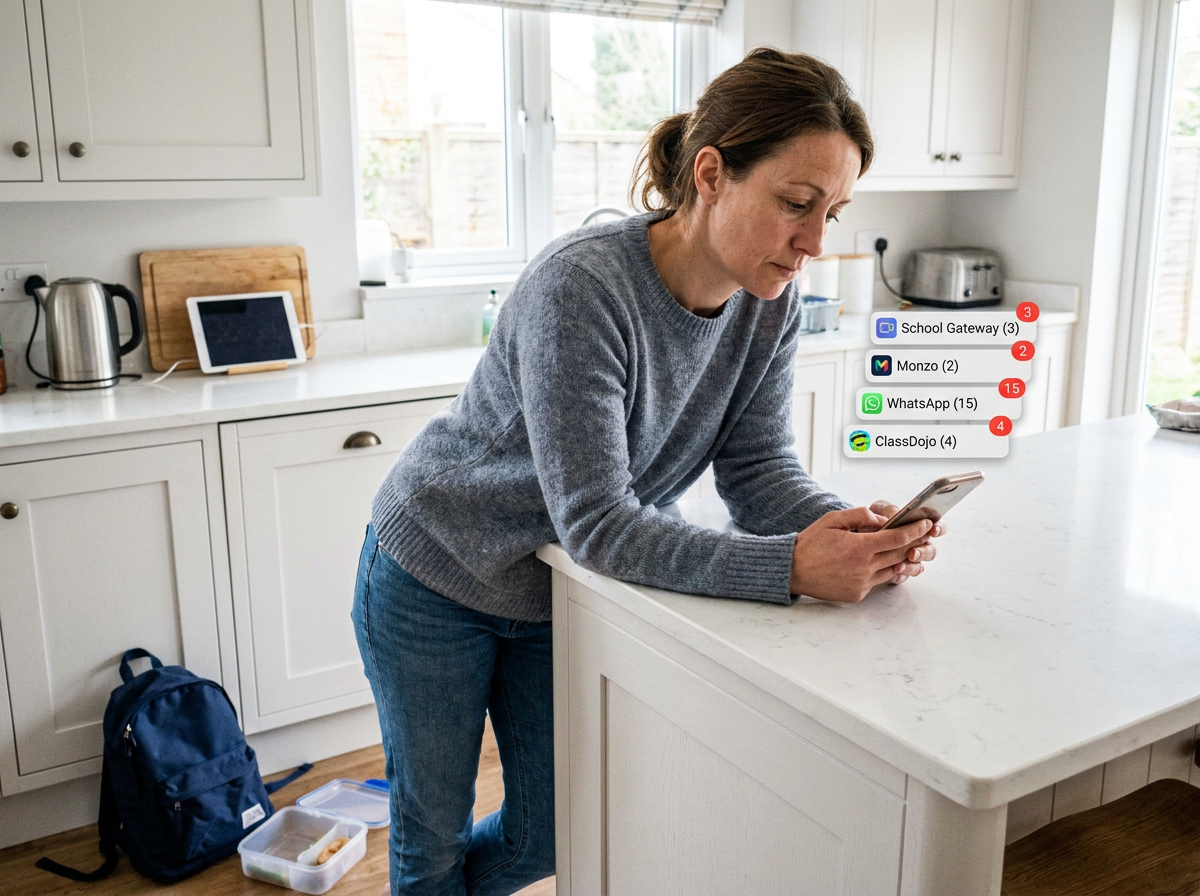
The school day is over, dinner needs sorting and somebody cannot find their PE top. Then the phone lights up: ParentPay, ClassDojo, Arbor, School Gateway, a Spond invitation for football training and a WhatsApp message about dance costumes.
Each message may take only a minute to handle. Together, they create a second shift of child-related administration that follows parents into work, family time and the evening. This is parent portal overload: the pressure created when important information is divided across school, club and activity apps, logins and inboxes.
Digital communication can make school life easier. Problems begin when every platform requires checking and parents must assemble scattered details into one complete picture.
The hidden work behind every notification
Parent portal overload is not simply about having several apps. It is about remembering which platform does what, deciding which messages need action and checking that nothing important has been missed.
These small jobs form a stream of micro-admin. Paying for a trip or responding to a training invitation may seem minor. Across several children, schools, sports teams and clubs, they become a continuous cycle of payments, kit, lifts, dates and availability updates.

Research into cognitive household labour helps explain why this feels exhausting. A 2024 study in Archives of Women’s Mental Health linked this invisible thinking with stress, burnout and poorer mental health. According to the British Psychological Society, mothers report carrying a disproportionate share.
School and club communication enters a family system where the administrative load may already be uneven. Another app may simply transfer more organising work into the home.
Why school app overload creates guilt
Messages about children carry unusual emotional weight. Missing a trip deadline, fixture update or themed day can leave a child disappointed or unprepared.
This can make a communication failure feel like a parenting failure. “Overdue” notices and last-minute requests can create anxiety when a parent cannot respond.
Constant access encourages the idea that engaged parenting means permanent availability. A parent may care deeply while working somewhere phones cannot be checked or managing additional needs.
More messages do not always mean better engagement
Schools need dependable ways to collect payments, share safeguarding information and communicate with hundreds of families. Digital platforms can simplify this work.
More communication is not automatically better communication. According to the Education Endowment Foundation, effective contact considers frequency, timing, audience and barriers.
When routine notices and urgent instructions arrive through the same channel, parents can become less able to distinguish what matters. Notification fatigue may eventually lead people to skim, postpone or mute the very apps intended to increase engagement.
The overload continues beyond school
Spond and similar platforms can make organising children’s activities easier for coaches and volunteers. Parents may see invitations, fixtures, cancellations, payment requests and transport questions in one place. The difficulty is cumulative: each club chooses its own system, while parents must manage the combined total.
One child’s football team might use Spond, swimming updates may arrive by email and a dance class could rely on WhatsApp. A last-minute change in one activity affects meals, lifts, siblings and work. The notification belongs to one child, but its consequences travel through the whole household.
Some families carry a greater burden
A household with one child and flexible work experiences communication differently from a family coordinating several schools and clubs. Separated parents may struggle to obtain equal account access, while grandparents and other carers may help with activities without receiving the same information.
Language, disability, neurodivergence and digital confidence affect how manageable messages feel. Payment requests can add stress for families under financial pressure.
A lack of response should not automatically be read as a lack of interest. It may mean the message was missed, the platform was inaccessible or each adult thought someone else had handled it.
What more thoughtful communication could look like
Schools may not be able to use one system for everything, but they can make their part more coherent. One clear guide should explain which channel is used for payments, homework, urgent notices and general updates. A weekly digest could gather non-urgent information, leaving immediate alerts for matters requiring prompt attention.
Clear subject lines such as “Action needed by 14 October: Year 6 consent form” are more useful than “Important information”. Dates, costs, year groups and required actions should appear in the message rather than several clicks away.
Schools could also audit communication from a family’s perspective. How many messages, platforms and passwords must a household manage? Speaking with shift workers, separated parents and families managing additional needs may reveal obstacles that platform data cannot.
Parents can reduce some pressure by checking school and activity apps at planned times, moving dates into a shared calendar and dividing complete areas of responsibility between adults. Clubs can help by giving reasonable notice, avoiding unnecessary reminders and making clear which messages require a response.
Communication should create connection
The strongest parent–school relationships are not necessarily those generating the most notifications. They are those in which families know where to look, understand what matters and feel able to communicate in both directions.
Digital platforms should reduce uncertainty rather than create constant vigilance. The answer cannot simply be for parents to become more organised or available. The better question is whether a real family could receive, understand and act on a message without one more small request becoming one more invisible weight.
Leave a Reply