
Affiliate disclosure: This article contains Amazon affiliate links. If you buy through one of these links, The Family Lens may earn a small commission at no extra cost to you.
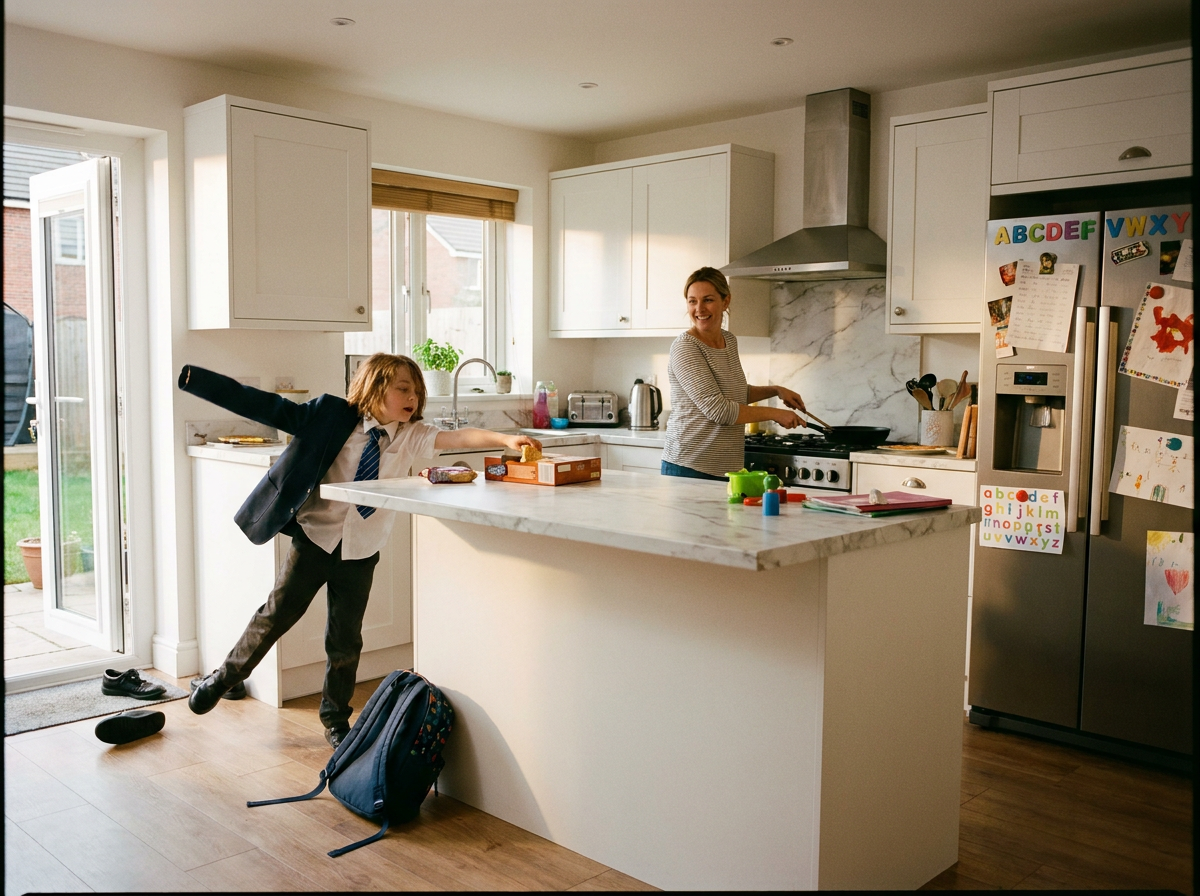
The hours between school and bedtime can ask a great deal of a family. Children arrive home hungry, tired or full of feelings held together all day. Parents may be starting dinner, locating sports kit and judging whether a child needs conversation, movement or peace.
A calmer evening rarely comes from one miracle product. It usually grows from a few predictable cues that tell everyone the school day has ended and home time has begun. These after-school reset essentials are not about filling the house with more things. They are practical tools that may remove small points of friction and help each child find the kind of transition they need.
Start with food they can reach easily
Hunger can turn an ordinary request into an impossible one. An accessible snack station gives children something they can manage for themselves while dinner is still some distance away.
A divided snack box works well for fruit, crackers, cheese and other familiar options. It can move between the fridge, kitchen table and car when activities begin soon after school.
Useful option: divided snack container or portable snack box

Choose something children can open and adults can wash easily. An attractive box will not earn its cupboard space if the clips frustrate small hands.
Create a landing place for school clutter
Many evening arguments begin with objects rather than people. Shoes block the doorway, letters remain in bags and the water bottle needed tomorrow disappears beneath a coat.
A row of labelled baskets or open storage cubes gives each child somewhere to drop the things that need attention. One basket could hold school paperwork, another library books and a third the kit required for that evening’s club.
Useful option: labelled storage baskets or open cube organiser
The aim is not a perfectly styled hallway. It is fewer decisions at the busiest point of the day.
Offer quiet without demanding stillness
Some children need silence after school, while others regulate themselves through movement, music or repetitive activity. A small reset basket can offer choices without asking a tired child to explain what is wrong.
Noise-reducing headphones may help a child overwhelmed by household sound. Colouring materials or a quiet fidget can provide another focus while they settle.
Useful options:
child-sized noise-reducing headphones
washable colouring pens and sketch pad
fidget
Not every child will find these helpful. A child who wants to talk, bounce on a trampoline or curl up beside a parent needs a different kind of support. The value lies in having a few familiar possibilities rather than producing the same solution for every mood.
Make time visible
“We are leaving in ten minutes” can feel surprisingly abstract to a child absorbed in a game or still recovering from school. A visual timer turns time into something that can be seen rather than repeatedly announced.
Useful option: visual countdown timer
This can support the whole household when homework, dinner and activities overlap. The timer becomes a neutral prompt instead of the parent repeatedly nagging, although flexibility still matters.
Keep homework physically comfortable
Not every child works best at a desk. Some prefer the floor, sofa or kitchen table, particularly when they have already spent much of the day sitting in a classroom.
A lightweight lap desk can create a portable surface for reading, drawing or short pieces of homework. It allows a child to remain near family life without balancing books uncomfortably.
Useful option: cushioned lap desk for children
The product matters less than the permission behind it: work can happen in a way that suits the child, provided the arrangement is safe and effective.
Use a simple evening checklist
Repeated reminders wear everyone down. A small magnetic or wipe-clean checklist can hold the routine outside the parent’s head: empty lunchbox, refill bottle, check tomorrow’s kit and put the bag by the door.
Useful option: magnetic family checklist or reusable routine chart
Keep the list short enough to be useful. A chart containing every desirable habit can quickly become wallpaper, while four essential steps may genuinely prevent the morning scramble.
Buy for the problem, not the promise
The most useful after-school reset essentials solve a difficulty already visible in family life. If belongings are always lost, storage may help. If transitions create conflict, a visual timer may be worth trying. If a child simply needs half an hour without questions, the best solution may cost nothing.
Before buying, check dimensions, cleaning instructions, age guidance and recent reviews. Consider where the item will live and whether the child is likely to use it independently. Products earn their place when they make everyday life easier, not when they create another routine for a parent to maintain.
A calmer after-school period does not need to look calm from the outside. One child may be drawing at the table while another runs around the garden and someone else eats crackers in silence. The real aim is not a picture-perfect routine, but a home in which everyone has a little room to come down from the day.
Leave a Reply