
Family holidays often begin long before anyone reaches the airport. They start with dozens of open browser tabs, competing opinions about destinations, questions about baggage allowances and the sudden discovery that someone’s passport expires sooner than expected. By the time the cases are packed, parents can feel as though they need a holiday from planning the holiday.
The most useful family travel tips are not about creating a flawless itinerary. Successful family travel usually comes down to choosing a trip that suits the people taking it, preparing for the predictable difficulties and leaving enough room to cope with everything else. Travelling with children will always involve a degree of uncertainty, yet it can also offer families time, experiences and conversations that are difficult to find within everyday routines.
Why family travel is worth the effort
Travelling as a family can be expensive, tiring and logistically complicated, which makes it reasonable to wonder whether the benefits justify the work involved. The answer will look different for every household, although family trips can provide something increasingly scarce: uninterrupted time together in a new environment (my personal favourite).
Children do not need to visit a long list of countries for travel to be valuable. A weekend in another part of the UK can introduce unfamiliar landscapes, local history, regional food and different ways of living. International travel can widen that experience further, helping children understand that their normal is not the only normal.
Meaningful experiences do not always come from the headline attractions either. They might come from working out a metro system together, ordering food in another language or discovering a playground behind the accommodation. These small moments give children opportunities to practise flexibility, communication and independence without feeling as though they are being taught a lesson.

Choose a destination that works for the whole family
A beautiful destination is not automatically a suitable family destination. Before booking, consider how the holiday will work from morning until bedtime. A remote villa might look idyllic, for example, yet the lack of shops, public transport or nearby restaurants could create extra work for the adults.
The ages and interests of the children matter too. Babies and toddlers often benefit from shorter transfers, flexible mealtimes and accommodation where naps are possible. School-age children might want pools, activities and opportunities to explore. Teenagers are more likely to engage when they have some influence over the destination and enough independence once they arrive.
Involving children in the planning process does not mean handing over the entire decision. Parents can choose two or three realistic destinations and let everyone discuss the advantages of each. Looking at maps, accommodation photographs and possible family activities gives children a clearer sense of what to expect and makes the trip feel shared from the beginning.
Weather, walkability and local transport deserve as much attention as the main attractions. A city full of interesting sights might be difficult with a pushchair if pavements are narrow and public transport is inaccessible. A hot destination could limit daytime activities more than expected. The practical details often shape a family holiday more than the destination’s most photographed view.
Set a realistic family holiday budget
The advertised price of a holiday rarely reflects its full cost. Flights and accommodation may be the largest expenses, although baggage charges, airport parking, transfers, food, tourist taxes, activities and travel insurance can add hundreds of pounds to the total.
A realistic budget should include spending before departure as well as spending at the destination. New swimwear, luggage, travel equipment and pet care can all affect the final figure. Families travelling during the school holidays may also face higher prices before they have considered any optional extras.
Working through each category in advance makes it easier to decide where to save and where comfort is worth paying for. A direct flight might cost more but remove a tiring connection. Accommodation with a kitchenette may reduce restaurant spending. Paying for reserved seats could make a flight less stressful, particularly when travelling with younger children.

Value is not always the same as choosing the lowest price. A cheaper booking can become expensive if it includes inconvenient flight times, distant accommodation or strict cancellation conditions. Good family travel planning considers the financial cost alongside the time, energy and additional pressure placed on everyone.
Book early, while keeping some flexibility
Booking early can provide a better choice of direct flights, adjoining rooms and family-friendly accommodation, particularly during popular school holiday periods. It also gives families more time to spread the cost and organise passports, insurance and travel documents.
Non-refundable rates require more careful consideration when children are involved. Illness, school commitments and changes in family circumstances can disrupt even well-established plans. The saving may be worthwhile for a short, low-cost trip, while flexible bookings can offer greater reassurance for an expensive family holiday.
Direct booking can sometimes provide clearer communication with a hotel or airline, especially when requesting a cot, accessible room, early check-in or information about children’s facilities. Package holidays can offer valuable financial protection and a single point of contact if something goes wrong. Neither approach is automatically better; the right choice depends on the trip and the family’s priorities.
Off-peak travel can mean quieter airports, smaller crowds and lower prices. Families with children below school age may have more freedom to take advantage of these periods. Parents of school-age children need to consider attendance rules and their school’s policy before making plans during term time.
Look beyond the words “family-friendly accommodation”
Family-friendly accommodation can mean anything from a hotel that accepts children to a resort built almost entirely around them. The description alone reveals very little, so it is worth checking which practical features are actually available.
Separate sleeping areas can transform a family trip. Sitting silently in a dark hotel room from 8pm while a toddler sleeps is very different from having a small living area or balcony. A kitchenette, washing machine or access to laundry facilities can also reduce packing and make longer stays easier.
Useful questions include:
- Is a cot available, and is there a charge?
- Does the room have a fridge?
- Are there safe balconies, windows and stairways?
- Is the swimming pool supervised or securely enclosed?
- Can children’s meals be prepared outside restaurant hours?
- How far is the accommodation from shops, transport and family activities?
- Are highchairs, stair gates or baby baths available?
- Will the room be affected by evening entertainment or traffic noise?

Reviews written by other families can reveal details that official descriptions miss. Look for comments from parents travelling with children of a similar age rather than assuming every family needs the same things. These real-life reviews are often much more helpful.
Build a family travel packing list
Packing for family travel can expand until every possible problem appears to require its own item. A family travel checklist helps separate genuine essentials from things that are merely reassuring to have nearby.
Packing by category can be easier than completing one person’s case at a time. Useful categories include clothes, toiletries, medication, documents, electronics, sleep items, entertainment and snacks. Parents can then check whether each family member has what they need within every category.
Hand luggage should contain anything that would cause an immediate problem if checked baggage were delayed. This might include medication, travel documents, chargers, a change of clothes, nappies, wipes, food and a child’s favourite comfort item. Older children can carry a small bag, although an adult should retain responsibility for passports, essential medication and valuables.
It is rarely necessary to bring enough equipment for every possible situation. Nappies, toiletries and basic food are available in most destinations, while baby equipment can often be hired. Checking what is available locally may save a great deal of space.
Prepare children for airports and long journeys
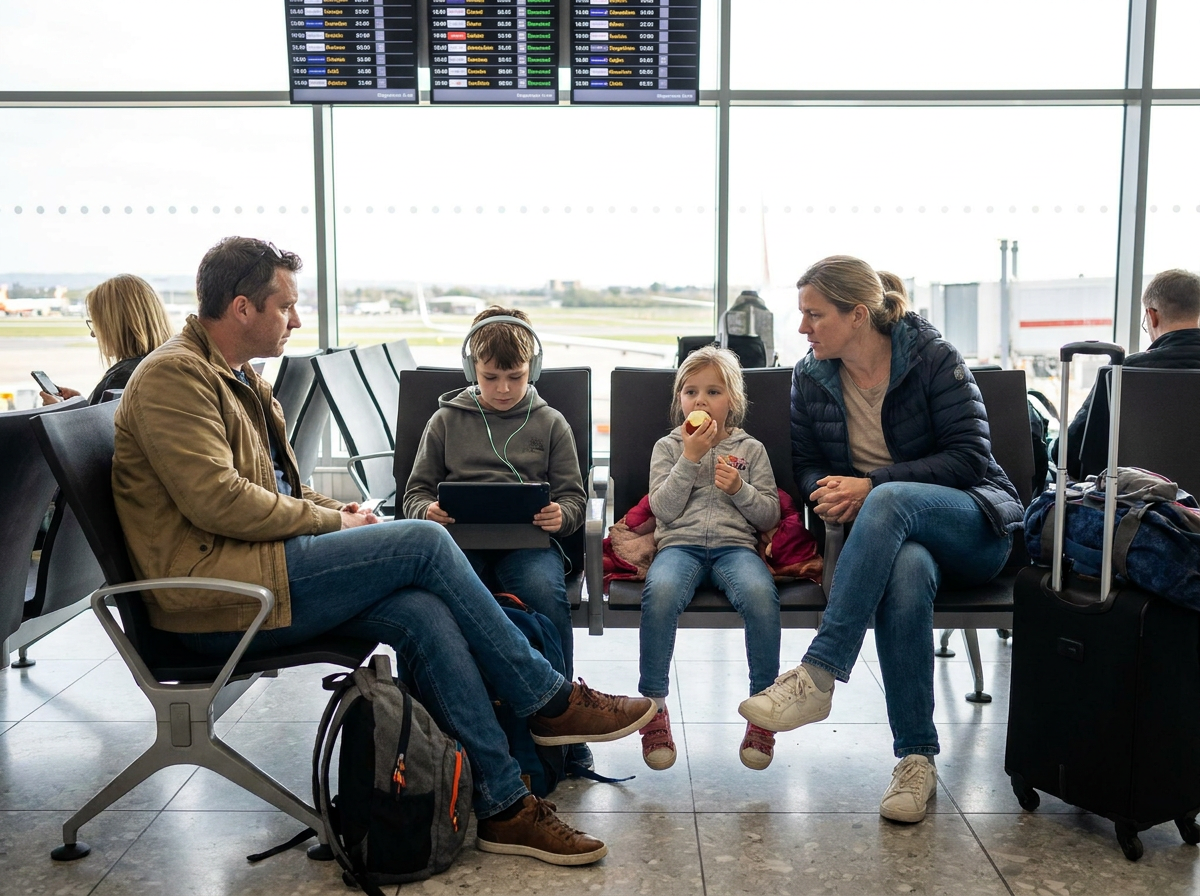
Adults sometimes forget how unfamiliar an airport can feel to a child. There are queues, security checks, loud announcements and long periods when very little happens, followed by sudden pressure to move quickly. Explaining the sequence in advance can reduce uncertainty.
Younger children may benefit from seeing pictures of an aeroplane, airport security and the inside of a hotel room. Older children can help check the departure board, find the gate or keep track of the day’s schedule. Giving them an appropriate role turns waiting into part of the experience.
Long journeys need a mixture of food, movement, conversation and entertainment. Download programmes, games and audiobooks before leaving home rather than relying on airport or in-flight Wi-Fi. Headphones, drawing materials and a few small surprises can help break the journey into manageable sections.
Screen time does not need to become another source of parental guilt during family trips. A film that keeps a tired child settled during a flight can be a useful tool. Balance can return when the family reaches the destination.
Allow more time than seems necessary
One of the simplest family travel tips is to build buffer time into every stage. Children need toilet stops, snacks and explanations. Shoes disappear just as everyone is ready to leave, while airport walks take longer with small legs.
Extra time reduces the number of moments when parents have to rush children through unfamiliar situations. It can also leave space for unexpected pleasures, such as watching aircraft from a window or stopping at a playground discovered on the way back to the hotel.

The same principle applies to the itinerary. Planning several major attractions each day may look efficient, yet it can leave everyone focused on reaching the next booking. One main activity, combined with flexible options, is often a better rhythm for family travel.
Protect sleep without letting routines control the holiday
Sleep affects everyone’s ability to cope. Tired children can struggle with transitions and stimulation, while tired parents have less patience available when plans change.
Familiar bedtime items can make new accommodation feel more secure. A favourite book, comfort toy, portable night-light or familiar music may be more useful than a case full of toys. Blackout blinds and white noise can help in some settings, although it is worth checking whether the accommodation already provides them.
Normal routines may need to bend. A nap might happen in a pushchair, bedtime may move later and breakfast might take place at an unusual hour. Protecting sleep means noticing when the family needs rest, rather than recreating the home schedule precisely.
Long-haul travel requires additional flexibility. A quiet first day gives everyone time to adjust to a new time zone instead of beginning with the most demanding excursion. Families returning home may also benefit from a recovery day before work and school resume.
Keep food and water close
Hunger can turn a minor delay into a family crisis surprisingly quickly. Familiar snacks are particularly valuable during flights, transfers and the first few hours at a destination.
Dietary requirements need more planning. Learning how to explain an allergy in the local language, checking airline meal arrangements and identifying nearby supermarkets can make the journey safer and less stressful. Medication for severe allergies should remain accessible throughout the trip.
Family-friendly accommodation with a fridge or kitchenette can simplify breakfasts and snacks. Eating every meal in a restaurant can become expensive and tiring, especially when children are adjusting to unfamiliar food. A mixture of local meals, picnics and simple food at the accommodation often works better.
Balance adult interests with children’s needs
A family holiday does not have to revolve entirely around children, although expecting them to enjoy an adult itinerary without compromise is rarely realistic. Museums, historic sites and walking tours can sit alongside pools, playgrounds and unstructured time.
Children are more likely to cooperate when they know their interests are included. A morning tour followed by an afternoon at the beach may work better than presenting every activity as compulsory. Teenagers can choose a restaurant, research an attraction or plan part of a day.
One-to-one time can also change the dynamic of a family trip. One parent might take a child swimming while another rests with a younger sibling. Older children might explore a market with an adult while everyone else remains at the accommodation. Families do not have to move as a single group throughout the entire holiday.
Make room for meaningful experiences
It is easy to measure a holiday by how many attractions were visited. Children may remember something entirely different: the cat outside the apartment, the busker in a town square or the evening everyone ate ice cream in the rain.
Meeting local people, trying regional food and learning a few useful phrases can make a destination feel real. Encouraging children to notice how everyday life differs from home often creates richer conversations than moving quickly between famous landmarks.
Photographs matter, although not every moment needs to be staged. The untidy, ordinary pictures often become the ones that best represent family memories. Children can also keep a simple travel journal, collect tickets or choose one photograph each day to preserve their version of the trip.
Stay flexible when things go wrong
Family travel rarely unfolds exactly as planned. Flights are delayed, weather changes and children become ill or overwhelmed. Flexibility is not evidence of poor planning; it is part of travelling with other human beings.
Abandoning an activity can feel wasteful when tickets have been purchased, yet pushing through may cost the family more in stress than the price of admission. A quiet afternoon at the accommodation can sometimes rescue the rest of the holiday.
Parents set much of the emotional tone during these moments, although remaining calm is not always easy. Lowering expectations, finding food, creating some space and deciding what genuinely matters can prevent one difficult hour from defining the entire day.
Complete the essential family travel checks
Passports, visas, entry requirements and health advice should be checked through official sources rather than relying on social media or an old article. GOV.UK provides current foreign travel advice for British travellers, including entry rules, safety information and local health considerations.
Travel insurance should be arranged as soon as the holiday is booked. The policy needs to reflect the destination, planned activities, existing medical conditions and value of the booking. Families travelling in Europe should also check whether each person has a valid Global Health Insurance Card, while remembering that a GHIC does not replace travel insurance.
Medication, prescriptions, emergency contacts and copies of important travel documents should remain easy to access. Child car-seat requirements vary between countries and transport providers, so these need checking before arrival rather than at the hire desk.
A final family travel checklist
Before booking
- Agree on a realistic budget.
- Check passport validity and entry requirements.
- Compare direct and connecting journeys.
- Research transport, weather and healthcare.
- Read cancellation conditions.
- Check what the accommodation actually provides.
Two weeks before departure
- Confirm flights, accommodation and transfers.
- Review travel insurance.
- Arrange prescriptions and medication.
- Create the family travel packing list.
- Download maps, tickets and useful travel apps.
- Discuss the journey with the children.
The day before travelling
- Check in online where possible.
- Download entertainment for offline use.
- Charge devices and power banks.
- Pack food, medication and spare clothes in hand luggage.
- Recheck passports, tickets and departure times.
- Leave enough time for an imperfect start.
Family travel is not a performance
The best family holidays are not necessarily the ones with the most expensive accommodation, the fullest itinerary or the most impressive photographs. They are the trips that work for the family taking them.
Careful planning can remove many avoidable pressures, while flexibility helps families manage the rest. Children will not remember every attraction or carefully chosen restaurant. They are more likely to remember how the holiday felt, the unexpected moments that made everyone laugh and the experience of discovering somewhere new together.
Leave a Reply