

For many families, the school year is punctuated by countdowns. How many weeks until half term? How many days until the summer holidays? How many years until GCSEs are over?
These conversations are so familiar that many parents find themselves asking one another, often while standing at the school gates, “How many more days until the weekend?” or “Not long until half term now.” The comments are usually light-hearted, shared with a knowing smile as everyone juggles busy schedules and tired children. Yet the ease with which these conversations happen raises an interesting question. Why do we so often talk about education as something to get through rather than something to experience?
There is, of course, nothing unusual about looking forward to a break. Adults count down to holidays too. What is perhaps more striking is how often school itself is spoken about as something to endure rather than enjoy. Children describe being exhausted. Parents talk about simply getting through another term. Even our everyday language can make education sound like an obstacle course rather than an opportunity to learn.
Is school the same as learning?
Children begin life with an extraordinary appetite for discovery. Long before they step into a classroom, they are asking questions, testing ideas and trying to understand the world around them. They build towers just to knock them down, ask why the sky changes colour and insist on knowing how almost everything works. Learning begins naturally, driven by curiosity rather than obligation.
School builds on that curiosity while carrying responsibilities that have grown significantly over time. Teachers are expected to deliver an ambitious curriculum, prepare pupils for examinations, support children’s wellbeing, safeguard vulnerable pupils and meet the needs of increasingly diverse classrooms. Few people would argue that it is an easy task, particularly when schools are expected to fulfil so many roles within society.
Perhaps this is where schooling and learning can begin to drift apart. As children grow older, conversations often become less about asking interesting questions and more about achieving the right answers. “Will this be in the exam?” gradually replaces “Why does that happen?” Neither question is unreasonable, yet they reflect very different relationships with learning.
The education families experience
Education does not stop at the school gates. Families experience it too. Parents juggle school runs, homework, reading records, packed lunches, forgotten PE kits, revision timetables, parents’ evenings and the constant stream of notifications arriving through school apps. Many also carry the emotional work that accompanies these practical tasks, helping children rebuild confidence after disappointing results, navigate friendship difficulties or manage worries that are far harder to solve than a maths problem.
Children, meanwhile, are balancing pressures that extend well beyond the classroom. They are expected to achieve academically while developing socially, making decisions about future careers, building resilience and learning to navigate a digital world that follows them home each afternoon. Education has become something the whole family participates in, even though only one member wears the school uniform.
This is not to suggest that previous generations had it easy. Every era brings its own challenges, and schools have always faced competing demands. Even so, many families may recognise the feeling that education has gradually become more complex, with expectations that stretch far beyond academic learning alone.
What do we really hope education gives our children?
Ask parents what they want most for their children, and exam results are rarely the whole answer. Most hope their children become kind, confident, resilient and capable of building meaningful relationships. They want them to think independently, adapt to change, solve problems and discover interests that continue long after formal education ends. Qualifications undoubtedly matter, yet few families would argue that certificates alone define a successful life.
According to the Education Endowment Foundation, children’s attitudes towards learning, alongside their confidence and sense of belonging, can have a significant influence on educational outcomes. These qualities cannot always be measured in a test, yet they often shape how young people approach challenges throughout their lives.
Perhaps this explains why education can sometimes feel like it is trying to achieve everything at once. Schools are expected to prepare children academically while also helping them become thoughtful, emotionally healthy and adaptable adults. Families share those hopes, even if there is no simple formula for achieving them.
The lessons that stay with us
Ask adults what they remember most vividly about school, and many are unlikely to begin with worksheets, spelling tests or mock exams.
Instead, they remember the teacher who believed in them when they doubted themselves. They remember the school production that built confidence, the science experiment that sparked a fascination, the book that changed the way they saw the world or the school trip that made history suddenly feel real. Those memories endure because they made learning feel meaningful.
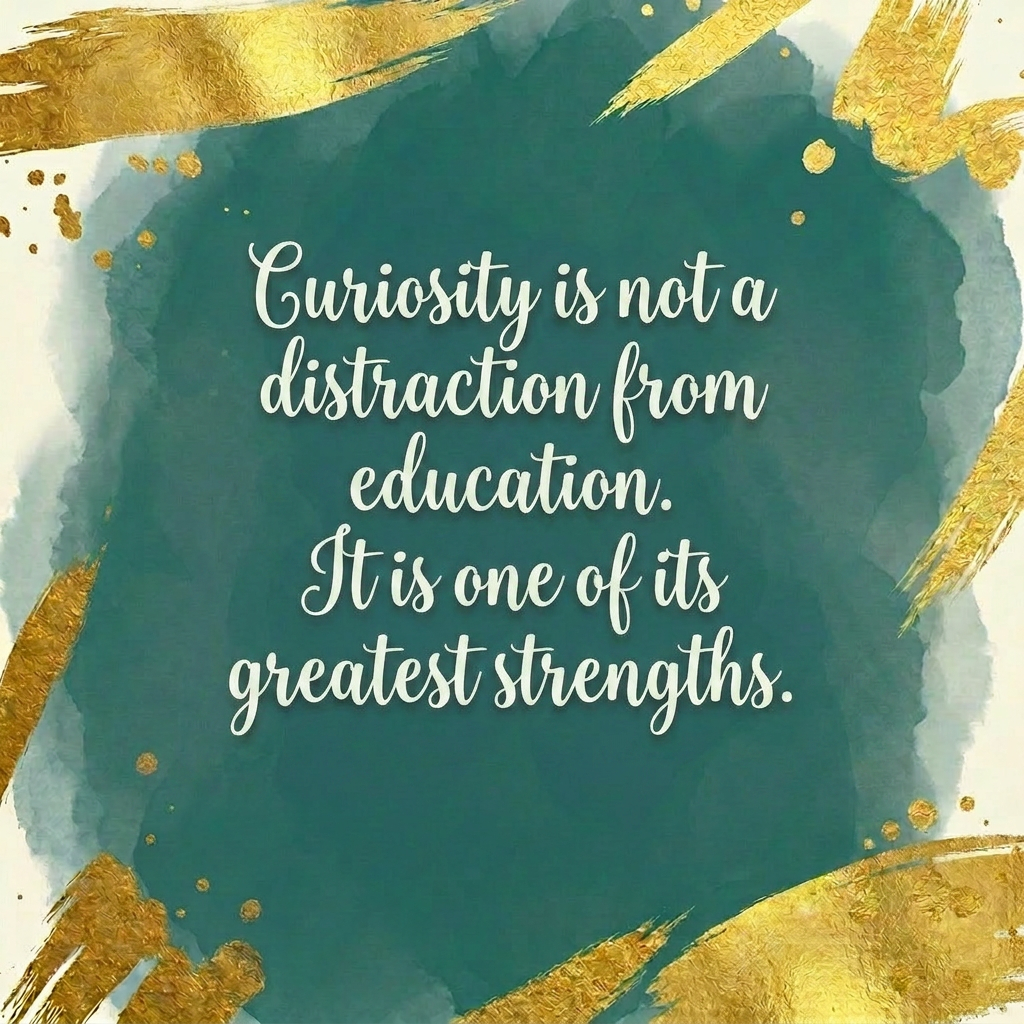
Educational psychologists have long recognised the importance of intrinsic motivation, the desire to learn simply because something is interesting. When curiosity is nurtured, children are more likely to remain engaged, persevere through challenges and continue learning beyond the classroom. That does not mean every lesson needs to be entertaining, nor does it suggest that examinations have no place. It simply reminds us that curiosity is not a distraction from education; it is one of its greatest strengths.
What this means for families
Families cannot redesign the education system, nor should that responsibility rest on their shoulders. They can, however, remind children that learning exists beyond timetables and classrooms. It happens while cooking together, visiting a museum, growing vegetables, fixing a bicycle, reading before bed or wondering aloud why something works the way it does. Those moments quietly reinforce the idea that learning is part of everyday life rather than something confined to school hours.
Perhaps the real question is not whether children should enjoy every school day. Few adults enjoy every working day either. The more interesting question is whether children leave school believing that learning itself is worthwhile.
Schools teach subjects, but families often shape attitudes towards learning. If children grow up seeing education as nothing more than a series of hurdles to clear before the next holiday, something important may be lost. If they leave with qualifications and a lasting curiosity about the world, education has given them something far more enduring than a certificate. It has given them the confidence to keep learning for the rest of their lives.
Leave a Reply